
Building 500 Million+ Views: A Study in Distribution, Attention, and Modern Media Systems
The internet likes to pretend that virality is mysterious. That it arrives without warning, that it is bestowed on a lucky few, that it cannot be engineered only hoped for. That belief is comforting, because it absolves people from doing the harder work of understanding systems.
This piece is about a system.
Over the last few years, I built and operated a short-form content distribution engine that crossed 500 million cumulative views across Instagram Reels and YouTube Shorts. The views came from repurposed long-form content primarily podcasts, interviews, and high-engagement YouTube videos from creators with strong narrative and emotional density, including the Sidemen, Adin Ross, Sneako, Rampage Jackson, Raj Shamani, PBD Podcast and more.
What follows is not a celebration of numbers. It is an attempt to explain why those numbers happened, and why similar outcomes are increasingly inevitable for anyone who understands how attention actually moves through modern platforms.
The Shift Most People Didn’t Notice
For a long time, content success was tied to ownership of an audience. You built subscribers, followers, email lists. Distribution was something you accumulated slowly, almost defensively.
Short-form platforms quietly inverted that model.
Instagram Reels and YouTube Shorts do not reward audience ownership. They reward attention performance. A piece of content is judged not by who posted it, but by what users do in the first few seconds after encountering it. Watch time, replays, pauses, rewinds these signals matter more than identity.
This shift fundamentally changes how media should be built.
When distribution is no longer scarce, but attention is, the job of a creator or operator is no longer to be visible it is to be irresistible for just long enough.
Why Long-Form Content Became the Raw Material
Long-form content remains the most efficient way to generate meaning. It allows for context, tension, personality, contradiction. But it is inefficient at scale. A forty-minute video may take weeks to gain momentum, and its reach is often capped by the creator’s existing subscriber base.
Short-form, by contrast, is inefficient at meaning but extremely efficient at reach.
The mistake many people make is treating these formats as competitors. In reality, they are complements. Long-form content is not meant to travel fast. It is meant to be mined.
Inside almost every long-form video with genuine engagement are dozens of moments that can stand alone for fifteen to forty seconds. Moments where emotion spikes. Where power shifts. Where something unexpected is said. These moments already contain the raw ingredients platforms reward: surprise, tension, relatability, dominance, humor.
The system I built treated long-form content not as finished media, but as source code.
From Clipping to Clip Farming
Clipping is manual. Clip farming is structural.
Instead of asking, “Which clip should I post?”, the question became, “How many high-retention clips can this single video produce, and how widely can they be distributed without dependency on any one account?”
At scale, this required coordination. Thousands of editors and operators worked in parallel, extracting, formatting, and publishing short-form content across a large network of accounts. No account was special. No clip was precious. What mattered was consistency, speed, and alignment with platform behavior.
The system was deliberately decentralized. Accounts were disposable. Identity was irrelevant. This removed emotional attachment from the process and replaced it with statistical thinking. When enough high-retention content enters the ecosystem consistently, outcomes stop feeling random.
Instagram Reels and the Physics of Reach
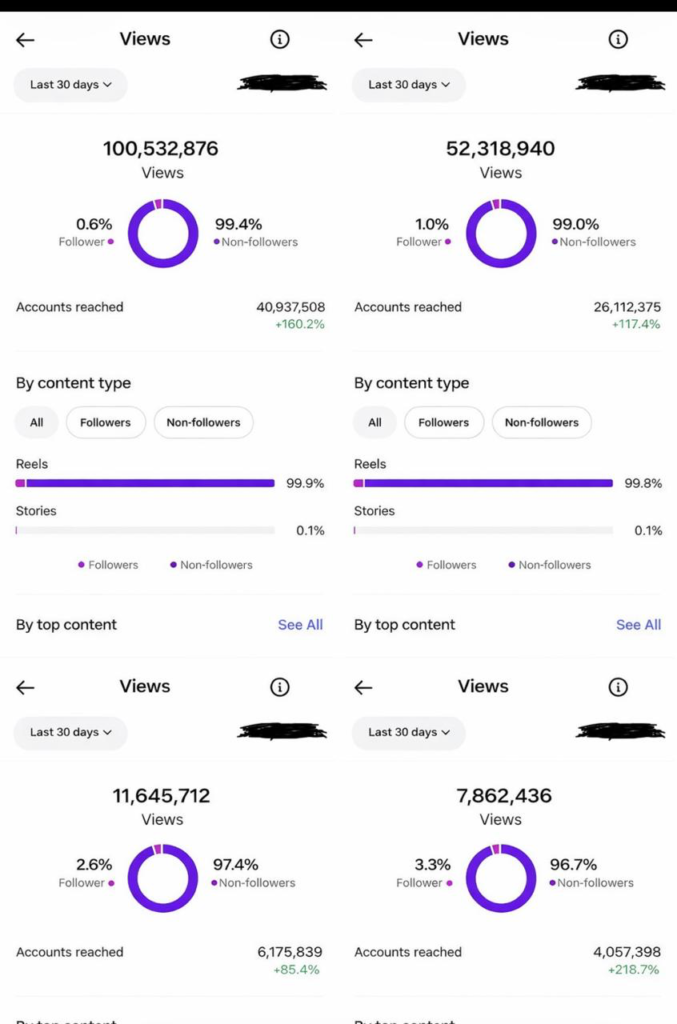
On Instagram, the results were clearest.
Across multiple properties, Reels generated view counts in the tens of millions over relatively short windows. In many cases, over ninety-five percent of views came from non-followers. This is not a vanity metric; it is a diagnostic one. It tells you that the algorithm, not the audience, is doing the work.
This only happens when content performs well in the first few seconds.
Most Reels failed. That was expected. The system was not designed to avoid failure; it was designed to make failure cheap. A small percentage of clips consistently triggered replays and extended watch time. Those clips were pushed further. Others quietly died. Nothing was forced.
What mattered was that the system could generate enough attempts for success to be inevitable.
YouTube Shorts and Compounding Attention
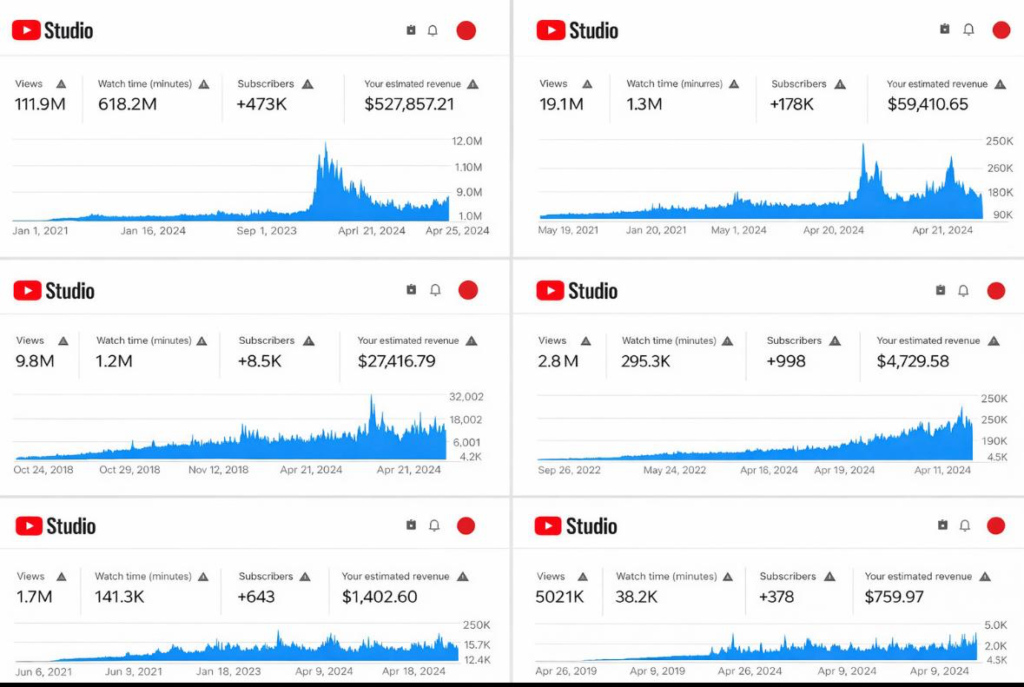
YouTube Shorts behaved differently, but just as predictably.
Where Instagram prioritizes velocity, YouTube prioritizes sustained satisfaction. Clips that held attention continued to resurface days or weeks later, often spiking multiple times across their lifespan. Several Shorts-only channels crossed seven to eight million views cumulatively, not through single viral hits, but through steady resurfacing.
This is where the long-term value of retention becomes obvious. When a clip continues to perform well, YouTube continues to test it. The platform treats content less like a post and more like an asset.
Short-form stops being ephemeral when it is engineered properly.
Editing as Cognitive Engineering
The editing philosophy behind this system was intentionally restrained.
There were no elaborate transitions, no aesthetic indulgences. Every decision served one purpose: reducing cognitive friction. Dead air was removed. Visuals changed frequently enough to prevent disengagement. Subtitles were functional, not decorative.
Most importantly, clips did not explain themselves.
They began inside motion, conflict, or speech. They ended before resolution. This was not manipulation—it was an understanding of how human attention works. The brain is drawn to incomplete patterns. Closure reduces curiosity. In short-form environments, curiosity is currency.
Why 500 Million Views Was Not Surprising
Large numbers feel impressive until you understand their mechanics.
Five hundred million views did not come from a single breakthrough. They came from alignment. Alignment between human psychology, platform incentives, and operational scale. When those three elements move together, growth stops being a miracle and becomes a consequence.
The system did not depend on timing. It did not depend on taste. It did not depend on a single creator or account. It depended on volume, feedback, and iteration.
In that sense, the result was not extraordinary. It was logical.
What This Means Going Forward
The implications extend beyond creators.
Brands, founders, media companies, and even B2B operators are entering a world where distribution is abundant but attention is scarce. The winners will not be those who shout the loudest, but those who understand how to compress meaning into moments that platforms want to extend.
Long-form builds trust. Short-form creates discovery. Systems connect them.
The future of media belongs less to personalities and more to architectures.

A Closing Thought
There is a tendency to romanticize content creation, to frame success as a reflection of talent or originality. In reality, modern visibility is far more mechanical than most are willing to admit.
That does not make it soulless. It makes it intelligible.
Five hundred million views were not chased. They were designed for.
And once you understand that, the internet starts to look very different.